Hey Friends ... sign up for my newsletter and get my
FREE Practice Checklist
Positive Coaching vs. Negative:
What Is Your Coaching Style?

Baseball coaches will have to choose between positive coaching and negative coaching.
It really boils down to which of the two communication styles you want to use coaching youth baseball.
I just do not beleive everyone on the team has to be miserable in order for one to be a good coach.
If you use the negative coaching communication style then you will take the skills of baseball and likely become a nagger. You will find yourself as a nag, nag, nag on every mistake, error, swing and miss or any misplay or boo-boo.
Rarely if ever will baseball players measure up to your standards. You have all seen a father criticize his child constantly and rarely if ever give them praise for anything because nothing is ever good enough.
| A coach is someone who can give correction without causing resentment. John Wooden |
That is how some youth sports coaches choose to communicate with their entire baseball team. The players will never ‘measure up in their minds.
Importance of Good Communication Skills
| "My responsibility is leadership, and the minute I get negative, that is going to have an influence on my team." Don Shula. |
Very few great baseball coaches have taken the art of communication and utilized the negative coaching approach.
John Wooden quoted above, was voted by the Sporting News as the greatest coach in history. I try really hard to use his line on effective communication to be able to teach without causing resentment.
Become a positive baseball teacher developing confident self-assured baseball players.
Realize the Game is Not That Easy
I think in order to use the positive coaching communication style you have to clearly understand one thing.
You have to have a deep appreciation of how difficult baseball is to play well. Baseball is a very difficult game to play.
Unless you realize the difficulty level then one is more likely to conform to negative communication styles.
The youth baseball coaches that truly ‘get-it’ and appreciate the difficult nature of performing baseball skills often gravitate to the positive coaching method.
That is why the great baseball coaches and professional baseball coaches avoid the negative coaching styles method.
5 Very Effective Communication Skills
1. Watch your tone: I watch the negative coaches yelling, screaming and shouting at their players across the field. Constantly embarrassing and belittling kids after a misplay or a swing and miss while hitting.
Even losing their ‘cool’ and having deep anger and a show of temper in their voices.
I choose the positive coaching method. I will do my coaching mainly between innings in the dugout away from the crowd.
I would rather ask questions and have the players do some critical thinking on the situation and have them explain their mindset.
Then I can reply with affirmation or minor corrections in a calm non-embarrassing light, away from the fray.
Teaching baseball is essential coaching method for positive coaching. Yelling and embarrassing ballplayers is not conducive to good learning communication.
Often volunteer youth baseball coaches have little or no background or training to teach kids. This lack of training often shows when they choose the negative coaching methods.
2. Be Aware of Your Body Language
Negative body language and facial expressions can be just as hurtful or demeaning as verbal words.
Positive coaches are careful to refrain from sending a negative headshake or waving our arms in disgust to our players.
Make a good use of communication skills by only using positive body language. After a swing and miss or a foul ball let the batter know you are pulling for them.
Give them some good body language vibes and some positive claps (along with ‘Hey, that’s the way to swing it!”)
3. Use Humor in your Communication Style
There is nothing wrong with keeping things light from time to time. Playing baseball tense and anxious inhibits baseball skills from rising.
Coaches and parents often take the game of baseball so serious they forget to enjoy the games.
Speak with a smile and it will be harder to come across as a mean coach with bad communication.
Avoid sarcasm though. One persons joke is not always funny to someone else.
had a player quit one time because I did not take enough time to listen to how bad a couple of their teammates were ‘picking on him.’ I kind of heard them but I just sort of let it go as sarcasm and having a joke.
But they were really picking on this kid day after day and I really dropped the ball by not putting a stop to the teasing. I felt sick when I finally realized how bad the situation had reached. I’m working on my lack of empathy character flaws so I do not miss this behavior in the future.
4. The Complement Sandwich:
Tips for Effective Communication
After watching youth baseball games for a while I think that it is about 10:1 ratio. That is 10 negative statements to 1 positive encouraging line.
I have no scientific proof or data on these bad communication assumptions but I know it is pretty close.
I like to use the complement sandwich. For every negative or corrective statement ‘sandwich' it with a couple good positive encouraging lines.“Hey Larry, that was a really good cut! You were just a little late on it. Now, get ready this time to swing it.”
Use two or three times as many positive complements and encouragement to any pessimistic, downbeat, unconstructive, unhelpful, disproving and harmful coaching statements.
| Study the pros. They aren't always right, but baseball IS their business. Why ask a butcher how to roof your house?.
|
5. Avoid the Post Game Verbal Lashing
Professional teams and some college teams often avoid meeting after a loss.
Why? Simply because a coach might be too emotional after a tough loss and communicate negatively after the heat of the battle.
I am not telling you to avoid a post game meeting but you might want to be aware of your emotions.
Keep the meeting short and if you have more to say wait until the next time you get together. Parents want to get going after the game and don’t want to held up by a lecturing upset baseball coach. Remember...positive coaching! It works a whole lot better. Just try it.
Similarly, avoid the post-game analysis on the way home in the mini-van with your kids. Youth players do not want to listen to you re-hash the entire ball game and nit-pick every player and second guess undermining the baseball coaches strategies.
And do not blame the umpires either. Try it if you think it looks easy.
Go back to Youth Baseball Today from Positive Coaching
Youth Baseball Home
More Coaching and Playing Tips Click to look at the Super Simple Guide to Coaching Baseball
Baseball Coaching 100 Point Checklist
Baseball Impossible: Player Development Make-Over
Build Your Own Culture of Player Development
&
Increase Your Players FUN Level
6-DVD Video Set Building Your Complete Player Development System
Click to Order
Audio CD Format Click Here
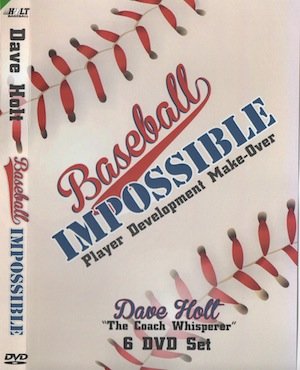
Coaching 6-DVD Box Set
Yes Dave, I Want to Help My Players Enjoy the GAME
Coaching little league baseball & youth baseball can be a blast or could be a Tough Gig.
Who in their right mind would come back year after year and have teasing baseball practice and never improve their baseball skills? and get welled at by adults?
Baseball Coaching Videos: Watch over 6 hours of tips on coaching approach, style, philosophy, and my unique player development system.
Youth baseball carers are short-lived so lets make it count for our players. What do players really want out of playing baseball?
I want to find out more about the 6 DVD Player Development System
How to
Jump-Start Your Coaching Skills
"5 Steps to Ultimate Baseball Coaching Excellence"
Who: All baseball & softball coaching age levels
What: Teaches approach, philosophy, practice planning, drills, game management, communication skills, player development methods, and more. No other course compares.
5 Steps to Ultimate Baseball Coaching Excellence
Order Now
High Tempo© Baseball Development Systems
New innovative, accelerated youth baseball practice and competitive game format made to increase player development and the kids have a blast.
High Tempo© Baseball Development Systems
Phase I: High Tempo© Team Practice System
Phase II High Tempo© Competitive Game Modification System
Order Now
3 Course Bundle...Best Value
Downloadable eBooks
Check out these vitally important eBooks to include in your coaching library.
"Time to Shine: My Baseball Coaches Practice System 7 Year Plan to Help Kids Reach HS Baseball
"Build Your Ultimate Culture of Hitting"
Take a look at all the coaching products that will make your coaching experience top of the line and help bring your player's enjoyment level much higher.

Hey, I just want to take a second to thank you for stopping by and visiting coach and playing baseball.com. Thanks for your service to baseball and our youth. We as adults have a special privilege and enormous responsibility to deliver to our baseball youth today.
Remember, "How a leader is more important than what a leader knows." American Express
I hope there is something you can take away from here that is helpful to your scope of practice, whether you are a player, coach, parent or administrator.
Please share and pass on my link to others in the game that would benefit. Thanks Again!
Blessings
